

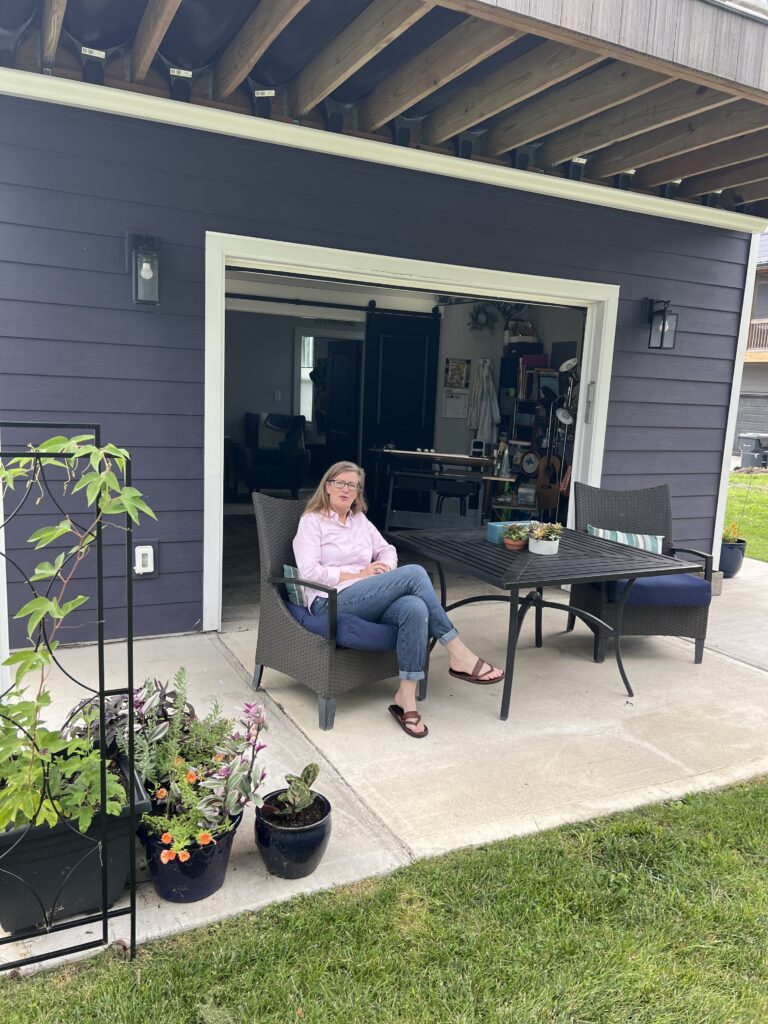
Carrie Tipton looks out over the Art Park from the upstairs writing loft of her new home in a magical enclave in Lexington’s historic East End, excited to finally have a space where she can put fingers to keyboard and paint to canvas.
Downstairs, sunlight spills into a dedicated art studio where her supplies are being unpacked alongside the myriad concepts Carrie has filed away in her head over the years.
The house itself—originally built and owned by visual artist Stephanie Say—is more than a place to eat and sleep. Tucked into The Artists' Village near Art Inc. Kentucky’s ArtHouse Gallery at The MET, it was designed as part of an innovative creative ecosystem: a neighborhood where artists can live, work, and grow in community with one another.
For Carrie, a lawyer returning to Kentucky after more than three decades in Northern Virginia, it feels less like relocating and more like coming home.
Stepping through the front door, visitors are immediately welcomed into an eclectic explosion of artwork, books, handmade objects, and personal treasures. Carrie’s own works play nicely on the walls with those of other artists. The atmosphere is colorful, warm and playful—an invitation into a creative’s world where anything is possible.
“This house was listed just as I was starting my search for a house here in Lexington, and the timing couldn’t have been more perfect,” Carrie said with a huge smile. “In fact, it was almost as if it was meant to be.”
Back to the Future: A Return to Creativity
Born in Oak Ridge, Tennessee and raised partly in Knoxville before her family moved to Winchester, Kentucky in time for her to attend high school, Carrie enrolled in every art class she could find. Although she originally began college as a fine arts major at the University of Kentucky, practical considerations prompted a redirection.
“Fine arts was my passion, and even though I switched over and went down the law track, I was still doing a lot of art on my own any time I had the chance,” Carrie remembers. “Any time someone needed a logo designed or a poster created, I was happy to help out.”
Through the years, the creative side of Carrie never disappeared. It simply had to coexist with her demanding life as a lawyer.
After finishing up law school in Virginia, Carrie spent more than 30 years in the Washington, D.C. area building a career focused largely on foster care, adoption, juvenile law, and representing children as a guardian ad litem. The work was meaningful but emotionally taxing.
“For a couple decades, that was my life,” she said. “It got to the point where there were days when I would come home so deflated that I would just lay on the couch and watch TV or scroll.”
Throughout those years, painting, mixed-media art, and creative writing remained in the background. She took classes when she could and nurtured a long-standing love of storytelling, even completing an English minor in college to stay connected to writing.
But creative work was often squeezed into the margins of her already crowded life. Like many artists, what she lacked was not desire. It was self-granted permission to once again take time and make space to create.
Seeking More Than a New Address
When Carrie decided to return to Kentucky, family was the driving force.
Her mother, brother, aunts, and uncles all live nearby. As loved ones aged and life in the D.C. area became increasingly difficult, Lexington began calling Carrie home.
“I’ve always felt like this is my home, even though Lexington is the place I’ve lived the shortest amount of time in my life,” she said.
As Carrie began the search for a place to call home, she realized that what she really wanted—in fact needed—was a new lease on life.
She imagined re-making her life in an older Craftsman bungalow with a sun porch she could transform into a studio. She wanted room for art supplies, works-in-progress, and the novel drafts she had carried from place to place for years. She wanted a home where creativity would no longer be an afterthought but the primary reason she got out of bed each day.
It became her daily ritual to scan all the well-known real estate apps, looking at Lexington listings and hitting the refresh button frequently. One day, up jumped a listing that stopped her mid-scroll—Stephanie’s just-listed home in The Artists' Village.
Discovering ‘Different’
Carrie drove to the neighborhood and began researching, and the more she learned, the more intrigued she became.
Developed by Community Ventures in partnership with Art Inc. Kentucky, The Artists' Village was intentionally designed around the needs of artists specifically seeking live/work dwellings, because each home includes dedicated studio space.
Every home in The Artists' Village opens onto a shared green space called the Art Park that encourages interaction not only between neighboring artists but with the entire East End community. It is a place designed to support performances, exhibitions, and neighborhood gatherings. The concept effectively connects affordable homeownership with artistic practice and community engagement.
For Carrie, the idea was revolutionary, and her lawyer mind kicked in: “I immediately started researching everything and looking at how this whole community was created.”
Rather than treating creative work as a hobby, The Artists' Village and Art Inc. Kentucky recognize it as valuable labor deserving of dedicated space and intentional infrastructure—and that vision resonated deeply with Carrie.
Just as compelling was learning about Art Inc. Kentucky’s broader mission of helping artists build sustainable creative careers through business training, professional development, exhibition opportunities, and community support, as well as assisting them in accessing the funding they might need to expand and grow their small business dreams.
Doubt Comes Creeping
There was only one problem—Carrie wasn’t quite sure she belonged in a neighborhood curated entirely around the arts.
Although highly accomplished in her professional career, Carrie couldn’t help but compare herself to the nationally recognized writers, visual artists, and arts leaders already living in The Artists' Village. The comparison triggered what Carrie identified as “imposter syndrome.”
“Even though this seemed like the perfect place for me, I found myself struggling to actually put an offer in,” she remembers.
To address those concerns, she wrote a letter to Stephanie explaining her background and her hopes for the future. Stephanie quickly responded, and what followed was a thoughtful conversation about creativity, community, and the many ways people become artists.
Friends encouraged Carrie, too. One lifelong friend reassured her, “I’ve never thought of you as a lawyer. I’ve always thought of you as an artist.”
Today, Carrie is grateful she listened. “I’m so glad I didn’t let this opportunity pass me by because of fear.”
A New Chapter Begins; a New Milestone is Reached
The home’s transfer from Stephanie to Carrie marks a milestone for The Artists' Village. As the first resale within the development, it represents the first time one artist-built home has passed directly to another artist-owner rather than being sold as new construction.
Award-winning glass artist Mark Johnson, President of Art Inc. Kentucky and himself an Artists’ Village resident, explains it like this: “Carrie’s arrival at The Artists' Village represents exactly what we hoped would happen here—that these homes would remain part of a living, ever-evolving creative community.
“The fact that she purchased her home from one of our original artist homeowners—the first time that has occurred—makes it even more meaningful. It shows that The Artists' Village is becoming something larger than just a group of residents. It's becoming a place where artists can build a life, find community, and where one artist’s chapter can beautifully make way for the next."
Energy Flows in a Home That Works
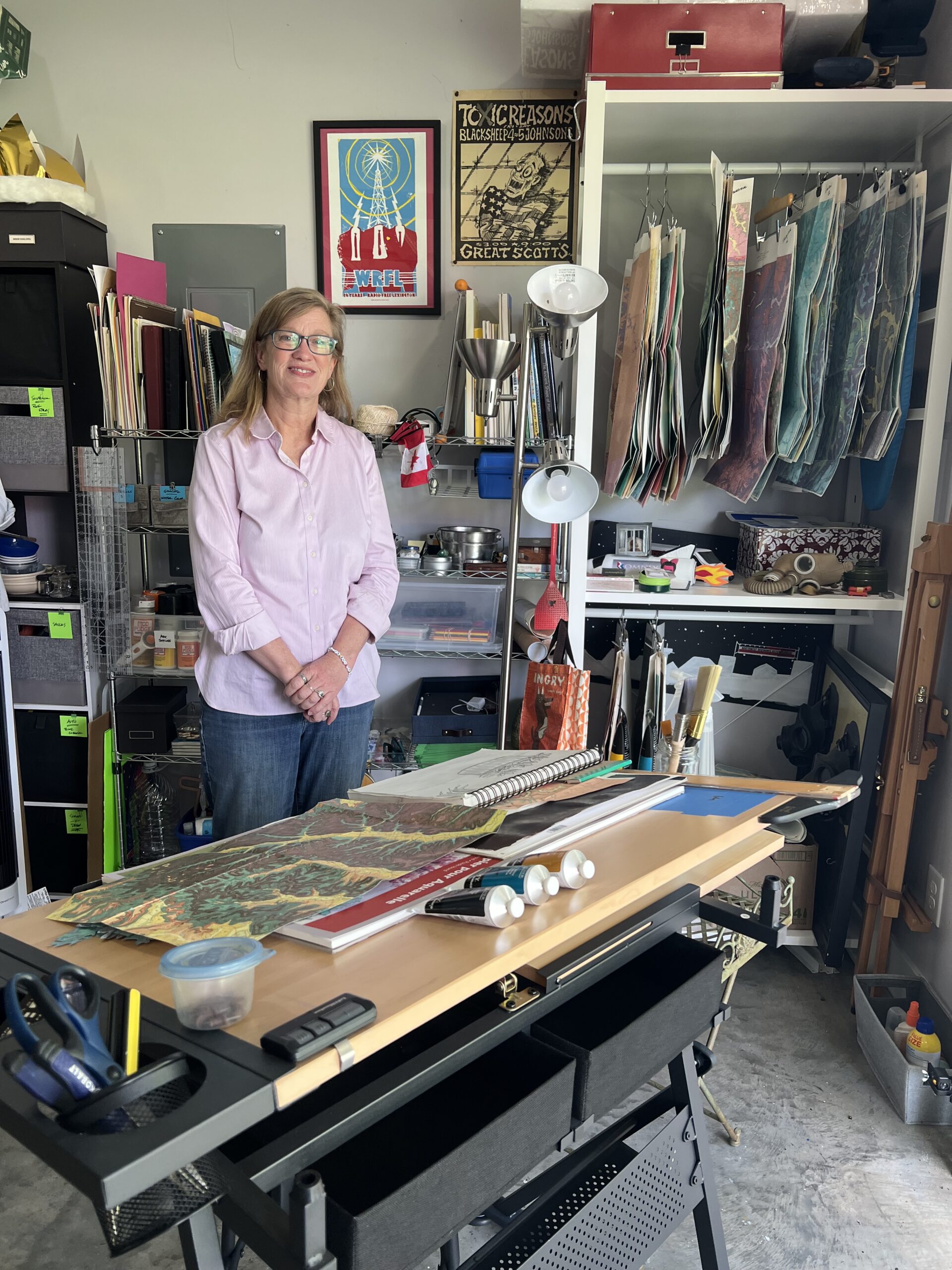
Now settled in, Carrie is filling the home with exactly the kind of creative energy she hoped to reclaim.
The downstairs studio offers room for experimentation, light, organization, and perhaps most importantly, a little mess-making. Carrie’s current 3D mixed-media project explores using historic geological maps acquired through the Lexington Creative ReUse Center as well as upcycled musical instruments. Several pieces currently in the works incorporate Appalachian imagery inspired by traditional quilt patterns.
Upstairs, her quiet space awaits the novels soon to be completed or yet to be created. It is where years of notes, drafts, and ideas will finally be unpacked and revisited.
“Even while I was still busy unboxing everything from the move, I was able to take a break and go into the studio at night and sit down and paint, or review something I wrote 15 years ago. That has been a godsend.”
Carrie has already re-enrolled in drawing and painting classes at the University of Kentucky and is eagerly exploring where her renewed creative energy might lead.
Community, Embraced
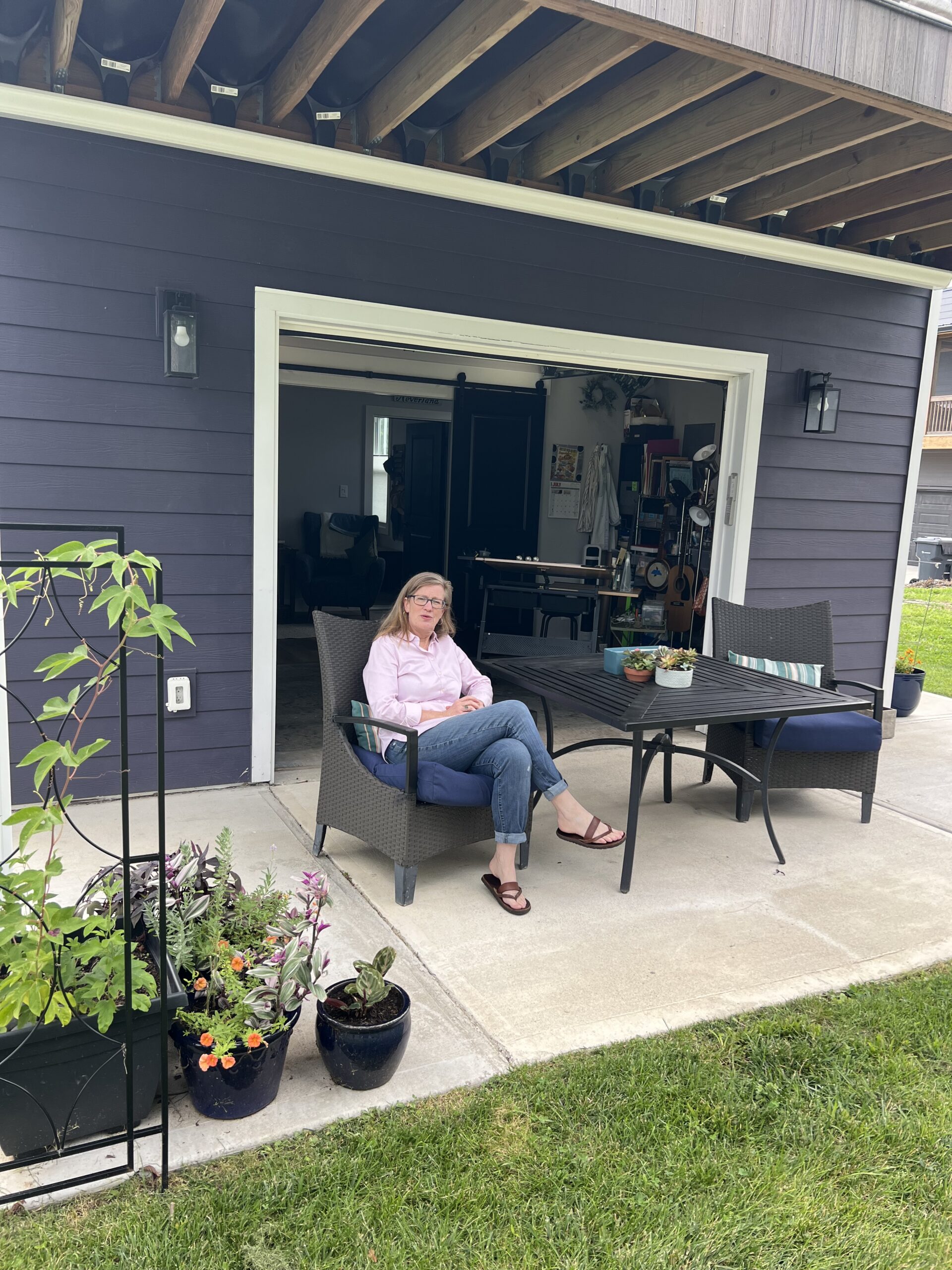
Just weeks after moving in, Carrie hosted a neighborhood gathering and has already built friendships throughout the Village.
The sense of camaraderie has exceeded her expectations. Instead of the pressure to perform up to a certain “standard” that she feared she would feel, her experience has been the just opposite.
“Nobody here has come up to me and said, ‘What have you sold?’” Carrie notes. “But everybody asks, ‘What are you working on right now? Let us know how we can help you.’”
Life among creatives offers a shared understanding of things commonly experienced: Creative blocks, unfinished projects, bursts of inspiration, and the vulnerability that comes with putting a part of yourself “out there” to strangers.
The best part for Carrie? Nearly constant encouragement, and feedback when requested. But most importantly, she notes, everyone’s creative endeavors are visible and valued.
A Creative Future, Currently Under Construction
For Carrie, the future is still unfolding, but she takes comfort in knowing that within The Artists' Village making art is a priority, not an afterthought.
She hopes to continue developing her artistic skills and gain confidence by participating in exhibitions and selling works at ArtHouse Kentucky. She also intends to contribute her support wherever and whenever the community as a whole—or individual members—need her.
And she believes deeply in sharing in the larger vision taking shape at The Artists' Village: A mission that combines artists, neighbors, creative business development, and intentional community building, all aimed at uplifting the historic East End that Carrie now calls home.