

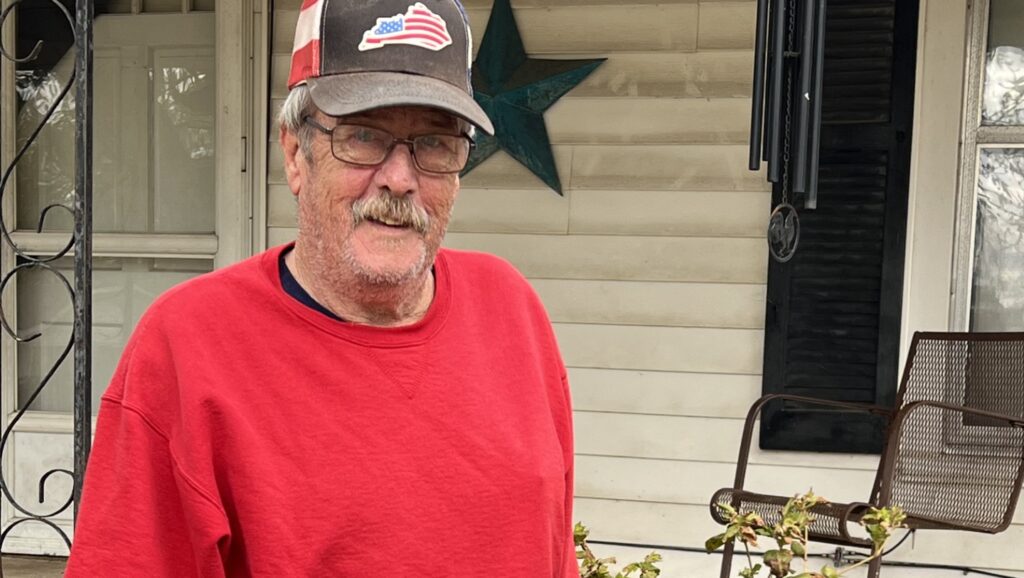
Floyd “Buddy” Mynear sat on his front porch in Millersburg on a crisp fall afternoon surrounded by various and sundry representatives of the neighborhood cat population while a tiny Pomeranian peered out the window, barking his enthusiasm from inside the house.
Buddy repeatedly pushed the biggest and most beautiful cat away—gently—with the end of his cane as it rubbed up against him.
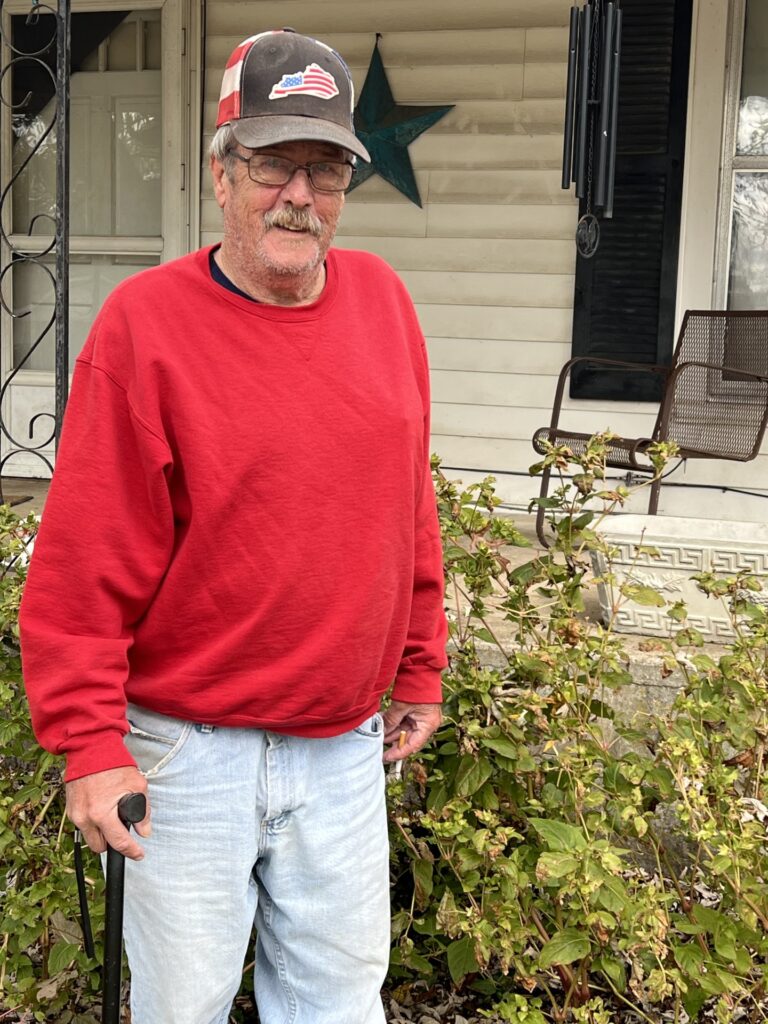
“Go on now, Fuzz. Get outta here.” The gruff words, clearly falling on deaf ears, stood in stark contrast to the bowls of cat food lining the porch. Whether Buddy liked it or not, his love of animals was quite evident.
For most of his life, Buddy has called Millersburg home.
“My real name’s Floyd, but I’ve been called Buddy all my life,” he said. “And Millersburg has been ‘home’ for most of my life.”
Though his family moved away when he was 12 years old, Buddy eventually found his way back to the small Bourbon County town he never stopped loving. After working on Central Kentucky horse farms for years and later spending 19 years with the City of Millersburg doing sanitation and street maintenance, he retired and settled into a house he and his wife, Bonnie, could finally call their own.
A Good Way, A Good Place
Like many longtime residents, Buddy has watched the town experience both prosperity and hardship. He remembers childhood days when local businesses lined the streets and neighbors kept a close eye on one another’s children.
“You’d get on your bicycle and ride down through town, and if you done something wrong, your parents would know it before you got home because the neighbor done told on you,” he laughed. “It was a good way to grow up. A great place to grow up.”
He also witnessed the community’s decline after Millersburg Military Institute finally folded and Joy Mining, the town’s last major industry, left.
“When you take that kind of money away from a little community like this, it put a hurt on us,” Buddy said.
Today, however, he sees signs of a comeback. New businesses are opening, concerts are being held on the town square and visitors flock to see the lights at Mustard Seed Hill during the Christmas season. The town is, overall, coming back to life.
“A lot of people come to see the lights,” he said. “To me, it seems like every year it has more people coming to town. Last year they added carriage rides, and I love horses—any shape and size—so I love that they did that. It reminds me of an old-time Christmas.”
A Hometown Home of Their Own
For Buddy and Bonnie, one of the most important reasons to stay in Millersburg is simple: it is home.
And thanks to funding through the U.S. Department of Agriculture Rural Development Housing Preservation Grant (HPG) program, remaining in their “forever” home has become much easier.
The USDA recently announced nearly $8 million in Housing Preservation Grant funding to support home repairs and rehabilitation projects in rural communities across the country. The funding helps nonprofit organizations like Community Ventures assist rural homeowners with critical repairs, offering both improved safety and quality of life.
In Kentucky, some of those funds are helping residents in Millersburg address long-standing problems that many fixed-income homeowners would be hard-pressed to tackle on their own.
“You can’t love a town without loving its people. When we can make life better for them, then we improve the whole town,” said Kevin Smith of Community Ventures.
For Buddy, the most pressing issue was his roof.
The home he purchased six years ago had been sitting vacant for more than a decade before he bought it.
“The house was in pretty bad shape,” he said. “When I bought it, it was all grown up, and the house had been sitting empty for probably 10 or 15 years.”
Overgrown and ramshackle, the property wasn’t much to look at, but Buddy saw potential.
“They thought I was going to fix it up and flip it,” he said of the previous owners. “I said, ‘No. We are living in the apartments down the street right now, and I’m going to retire. I want a place to live.’ so they agreed to sell it to me.”
He bought the house for $6,000 and set about improving it himself.
“I figured if I could get it for $6,000, I could do a little work to it myself and have a place that we could call our own.”
Over time, however, some repairs became too large and too expensive to handle alone. The aging roof had deteriorated to the point that Buddy could not obtain homeowner’s insurance.
“I was talking to Scotty True (Community Ventures’ Director of Maintenance) and told him I needed a couple new doors—my front door and my back door—because they were in bad shape,” Buddy recalled. “A couple days later he called back and asked, ‘What about a roof? Would you be interested in a roof?’”
Mynear was surprised, in a good way.
“I said, ‘Yeah,’ because I couldn’t get homeowners’ insurance because of my roof. It was too old.”
Through the Housing Preservation Grant program, Buddy’s home received a new roof and gutters, which the home had also been missing. Other improvements, which include the doors and other repairs, are being planned as additional funding becomes available.
“The next thing I knew, I had a roof and gutters, too,” he said. “I really appreciated that.”
The impact was immediate. When Buddy was asked whether he was finally able to obtain insurance coverage he said, “Yeah, but only because of the new roof and gutters.”
A new roof and gutters provided Buddy significant peace of mind.
“I was living there without insurance,” he explained. “If something happened, it wasn’t so much about me, but if something happened to my neighbors’ homes, like a fire here that spread, I’d be responsible for their stuff too. The new roof meant I could finally get insurance.”
Buddy cocked his head and laughed, thinking about another practical concern:
“I said it wasn’t about me, but I really wouldn’t want to live in a tent in the yard either if I lost my house in the dead of winter.”
Fund Keeps Rural Residents Blooming Where Currently Planted
Being able to complete repairs provides more than just physical shingles and gutters. It provides stability and security for homeowners who want nothing more than to remain lifelong members of the communities where they have lived their lives and made their memories.
For Buddy, that sense of connection runs deep. Even after moving away as a child, Millersburg drew him back home, and he hopes to remain there for years to come.
For its part, Community Ventures is administering the grant funds in Millersburg and serving as the local partner and boots on the ground overseeing the rehabilitation process, coordinating contractors, and ensuring repairs meet quality standards before work is approved. The organization is also engaged in broader revitalization efforts throughout the community, from housing to business development.
But the real story is found in longtime residents like Buddy and Bonnie who take pride in their community, who have worked their entire lives, and who simply need some financial help addressing major repairs that have become difficult to manage in retirement.
Buddy doesn’t mince words in his advice for others who may find themselves in a similar situation and who qualify for the funding.
“The only thing I can say is if you need it, if it’s out there, don’t be ashamed to get it,” he said. “I worked every day. I put 47 years into the workforce. I was able to retire, and this is where I want to stay.”
As Millersburg continues its steady comeback, programs like the USDA Rural Development Housing Preservation Grant are helping ensure that longtime residents can remain part of that future. For Buddy and Bonnie, it means continuing to live safely and comfortably in the town they love, in a house they can call their own.
“Millersburg is our home,” Buddy said. “We love it here.”
To learn more about home repair assistance and eligibility, contact Jon Brooks, Community Ventures Real Estate Project Manager, at jon.brooks@cvky.org or 859-231-0054, extension 1181.